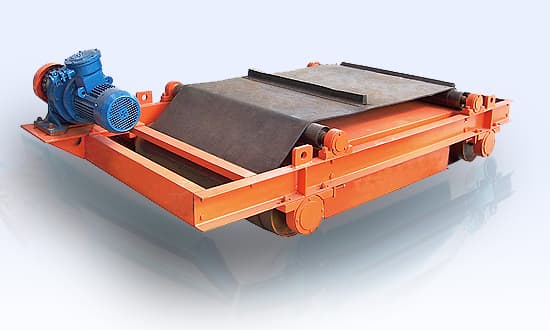
Defined magnet position
The separator is selected around the actual conveyor path, discharge point and available suspension space.
The RCYD permanent magnet self-dumping iron remover is an overhead magnetic separator for conveyor lines where ferromagnetic tramp material needs to be removed from a bulk stream before it reaches downstream equipment. Its role is practical: pull ferromagnetic pieces away from the conveyed material and move captured material to a defined discharge point through the self-dumping arrangement.
It is normally discussed for lines handling ore, aggregate, coal, recycled material or other bulk solids. Correct selection depends on the actual belt width, belt speed, material layer depth, suspension height, expected size and frequency of tramp iron, and the space available for a safe discharge zone. COWIN MAGNET supports selection discussions, OEM/ODM configuration, sourcing coordination and export follow-up for industrial buyers.
The separator is selected around the actual conveyor path, discharge point and available suspension space.
Manual cleaning suits lower contamination where a safe service stop is acceptable; self-cleaning is considered for continuous discharge requirements.
Belt width, speed, material layer depth and the largest expected tramp item are required before a model can be confirmed.
Dust, temperature, power availability and access for maintenance should be reviewed with the installation layout.
The diagram is a planning aid. Final positioning is confirmed from the line layout and the material duty.
These diagrams support preliminary discussion. Final dimensions and installation details are confirmed for the selected configuration.


Published model references are shown where available. Final technical details are confirmed from current product records, material and site conditions.
| Reference field: 项目 / 参数 | Suitable belt width (mm) | Reference field: 额定吊高 h=mm | Material burden thickness (max. mm) | Magnetic field reference | Reference field: 驱动功率 ≤kw | Belt speed (max. m/s) | Duty cycle | Weight (kg) | Reference field: 外形尺寸mm | Reference field: 外形尺寸mm | Reference field: 外形尺寸mm | Reference field: 外形尺寸mm | Reference field: 外形尺寸mm |
|---|---|---|---|---|---|---|---|---|---|---|---|---|---|
| 型号 | 适应带宽 mm | 额定吊高 h=mm | 物料厚度 ≤mm | 磁场强度 ≥mT | 驱动功率 ≤kw | 适应带速 ≤m/s | 工作制 | 重量 kg | 外形尺寸mm | 外形尺寸mm | 外形尺寸mm | 外形尺寸mm | 外形尺寸mm |
| RCYD(C)-5 | 适应带宽 mm | 额定吊高 h=mm | 物料厚度 ≤mm | 磁场强度 ≥mT | 驱动功率 ≤kw | 适应带速 ≤m/s | 工作制 | 重量 kg | 500 | 150 | 100 | 60 | 1.5 |
| RCYD(C)-6 | 600 | 180 | 130 | 60 | 1.5 | 920 | 2050 | 780 | 1030 | 1100 | 753 | ||
| RCYD(C)-6.5 | 650 | 200 | 150 | 70 | 1.5 | 1200 | 2165 | 780 | 1080 | 1200 | 888 | ||
| RCYD(C)-8 | 800 | 250 | 200 | 70 | 2.2 | 1400 | 2350 | 796 | 1280 | 1300 | 1088 | ||
| RCYD(C)-10 | 1000 | 300 | 250 | 70 | 3.0 | 2120 | 2660 | 920 | 1550 | 1400 | 1335 | ||
| RCYD(C)-12 | 1200 | 350 | 300 | 70 | 4.0 | 3350 | 2860 | 1010 | 1720 | 1550 | 1515 | ||
| RCYD(C)-14 | 1400 | 400 | 350 | 70 | 4.0 | 4450 | 3225 | 1050 | 1980 | 1800 | 1755 | ||
| RCYD(C)-16 | 1600 | 450 | 400 | 70 | 5.5 | 6200 | 3350 | 1180 | 2160 | 1950 | 1850 | ||
| RCYD(C)-18 | 1800 | 500 | 450 | 80 | 5.5 | 8100 | 3580 | 1210 | 2450 | 2200 | 2130 | ||
| RCYD(C)-20 | 2000 | 550 | 500 | 80 | 7.5 | 9700 | 3800 | 1300 | 2700 | 2400 | 2410 |
Send the process details with the product pre-selected in the inquiry form.
Start product inquirySelf-cleaning is normally considered where ferrous contamination must be discharged continuously. Manual cleaning may be appropriate when contamination is low and the line can be isolated safely for service.
The installation direction depends on belt speed, burden depth, the discharge side, available headroom and the required exposure to the magnetic field. The conveyor arrangement should be reviewed before selection.
Please provide belt width, speed, material layer depth, suspension height, material description, the largest expected tramp item, desired cleaning method and a layout drawing or photos when available.
No. A magnetic separator is used for ferromagnetic contaminants. Non-ferrous metals and non-magnetic stainless steel require a different separation or detection stage.

Your inquiry is tagged with this product page, product family, language, referrer and campaign data for the COWIN MAGNET team.