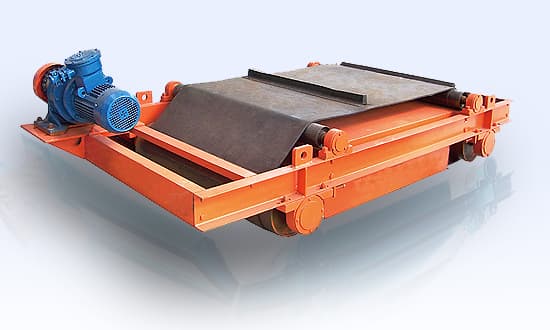
Construction and demolition recycling lines handle a material stream that can change from load to load. Concrete, brick, timber, soil, plastic, wire, bolts, nails and reinforcing steel can appear together before the plant has had a chance to size or classify them. That variability creates a practical question before any crusher or shredder is selected: where can ferrous pieces be removed early enough to reduce the chance that they enter equipment not intended to receive them? A self-cleaning suspended magnet is one possible answer, but it is only useful when its location, discharge route and cleaning arrangement fit the actual conveyor. This article uses two public UK references as context for a process discussion. It does not suggest that COWIN MAGNET supplied either referenced facility.
Why crusher protection deserves a separate decision
Industry context from public sources
The Environment Agency publishes standard rules for waste transfer stations that accept construction, demolition and excavation waste. Its SR2022 No 3 guidance was updated on May 1, 2026. The rule set is not a magnet specification, but it is a useful reminder that a recycling operation needs a defined material flow, an operating boundary and a way to manage foreseeable risks. Separately, Bath and North East Somerset Council states that construction of a replacement recycling centre began in February 2026 and that the site is designed to receive waste without processing it on site. That distinction matters. A receiving or transfer location may need traffic, storage and segregation planning, while a processing location must also decide where conveyors, magnets, crushers, screens and discharge points belong. Equipment should be considered at the point where the material is actually processed, not simply where it first arrives.
What a self-cleaning suspended magnet does
An RCYD permanent self-dumping iron remover is an overhead magnetic separator discussed for conveyor lines carrying bulk material where ferromagnetic tramp pieces need to be moved away from the conveyed stream. In a C&D application, the target may include reinforcing bar fragments, nails, bolts, wire or other ferrous pieces that can damage or complicate downstream processing. The magnetic assembly attracts suitable ferrous material. The self-dumping arrangement then moves captured material to a planned discharge point, allowing the conveyor line to continue when the duty and site layout support that arrangement. It does not classify every material in a mixed stream, remove non-ferrous metals or replace a metal detector. Those are separate duties that may need different equipment positions.
Process position and equipment roles
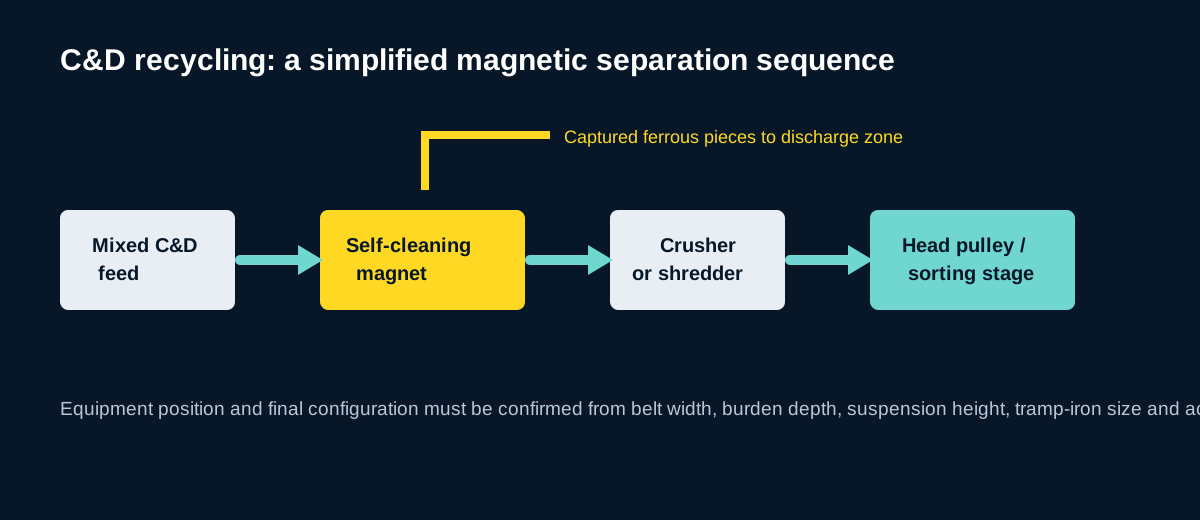
For crusher protection, the usual engineering question begins upstream of the crusher feed. The sequence can be described simply: mixed C&D feed reaches a conveyor; the material layer passes beneath a suspended magnet; suitable ferrous pieces are drawn out of the burden and carried toward a defined discharge zone; the remaining material continues to the crusher or shredder. A head pulley or drum magnet may have a different role at a discharge point, while an eddy current separator is normally considered later in a prepared stream when the objective is non-ferrous metal sorting. Treating these devices as interchangeable can create a layout that looks complete on paper but leaves the original risk unresolved.
Update Note 5
The magnet should not be placed by habit. It needs a section of conveyor where the material layer is reasonably stable and where the magnet has a realistic working relationship to the belt. A transfer point with uncontrolled material trajectory may be less predictable than a straight conveyor section. The captured-metal discharge path also matters. Ferrous pieces need a safe landing area that does not return material to the feed, interfere with access routes or place maintenance staff below an active discharge. The self-cleaning belt, its guarding and the discharge side require clear space. The selected direction can be cross-belt or in-line only after the physical geometry has been reviewed.
Selection inputs that change the answer
No useful selection can be made from a product name alone. The first group of inputs is conveyor geometry: belt width, belt speed, burden depth, suspension height and available structural support. These factors affect whether the separator can be placed at a useful distance from the material. The second group is the contamination profile: the expected ferrous-piece size, shape, frequency and whether long wire or rebar is likely. A line with occasional small pieces may lead to a different discussion from a line receiving frequent heavy fragments. The third group is operation: hours of operation, access for inspection, dust, moisture, temperature, available power where relevant and the space available for a discharge zone.
Update Note 7
Material preparation also affects the process. A large, uncontrolled incoming C&D stream can contain oversized material that creates an uneven burden. In that situation, the first task may be to stabilize feeding or screen the material before expecting consistent separation. Conversely, after crushing and sizing, a different magnet position may be appropriate for recovering ferrous material from a more uniform fraction. The point is not to put a magnet at every stage. The point is to match one equipment role to one identified risk or recovery objective, then confirm that it fits the physical line.
When a self-cleaning arrangement is not the automatic choice
Self-cleaning discharge is often considered where captured ferrous material appears frequently and a manual-cleaning routine would interrupt the line. It should not be described as the automatic answer for every plant. A line with low tramp-metal frequency, limited discharge space or planned stoppages may justify discussing a different cleaning arrangement. The equipment selection should also account for the safety of access to the magnet and any associated conveyor. If the magnet cannot be inspected, cleaned or guarded safely in its intended position, the proposal needs to change before a model is chosen.
Update Note 9
Likewise, a suspended magnet is not a substitute for detecting every metal type. Magnetic separation is directed at ferromagnetic material or magnetic fractions. Non-ferrous sorting has different process requirements. If the buyer needs to identify metal contamination rather than remove it, a conveyor metal detector may be part of the conversation. If the objective is aluminum or copper recovery from a prepared fraction, an eddy current separator belongs in a later sorting stage after appropriate ferrous removal and size preparation. Keeping these functions distinct helps avoid claims that one device can solve every contamination or recovery task.
A practical line-review checklist
Before requesting an equipment discussion, collect a short set of site facts. Identify the material being conveyed and whether the stream is raw inbound C&D, a post-screen fraction or crusher discharge. Record the belt width, belt speed and average as well as maximum burden depth. Measure or estimate the suspension height available below the support structure. Describe the likely ferrous contaminants and their largest expected dimensions. Photograph the proposed location from the side and from the discharge direction. Show adjacent walkways, guarding, transfer points and any area where captured material could fall. State whether continuous discharge is required and whether the line can be stopped for planned cleaning.
Update Note 11
This information is more valuable than an unsupported performance claim. It lets the selection discussion focus on installation feasibility, not only magnetic terminology. It also helps separate product-protection duty from recovery duty. A crusher-protection magnet may be positioned before a high-risk machine. A later head pulley or drum can be reviewed for another separation stage. A downstream non-ferrous separator can be assessed when the material has been prepared for that purpose. Each choice should have a clear reason in the process.
Key takeaways
Public recycling and waste-transfer updates show why process boundaries matter: receiving waste, processing waste and recovering material are related but not identical activities. For a C&D processing line, a self-cleaning suspended magnet is most useful when it is tied to a defined conveyor position, an identified ferrous risk and a safe discharge route. It can support early removal of suitable ferrous tramp pieces before downstream machinery, but it does not replace non-ferrous sorting or metal detection. COWIN MAGNET supports selection discussions, OEM/ODM configuration, sourcing coordination and export follow-up for industrial buyers. Final configuration should be based on the material, belt data, installation layout and operating conditions rather than a generic model recommendation.
Source and method
This article is an original technical interpretation based on public information from the Environment Agency, GOV.UK, updated May 1, 2026, and Bath and North East Somerset Council, accessed August 8, 2026. The external references are used only for facility and operating context. Product-position guidance is limited to general magnetic-separation principles and the documented role of the referenced COWIN MAGNET product. Send material details, belt width, belt speed, burden depth, suspension height and site photos through the request-for-quote page for a project-specific discussion.
Source References
External references are cited for context. Cowinmagnet adds its own analysis and buyer-focused interpretation.
FAQ
Should a suspended magnet be installed before or after a C&D recycling crusher?
For crusher protection, the first discussion is normally upstream of the machine. Belt width, burden depth, suspension height, tramp-iron size and safe discharge space decide whether that position is workable.
When is a self-cleaning arrangement considered?
It is commonly considered where captured ferrous pieces appear often enough that manual cleaning would interrupt the line or create an unsafe task. The discharge path and maintenance access still need to be reviewed.
Can the same magnet recover all metals from a recycling stream?
No. A suspended magnet addresses ferromagnetic pieces. A downstream eddy current separator is used for non-ferrous metal sorting after suitable preparation.
What information should be supplied for an equipment discussion?
Provide the material, belt width, belt speed, burden depth, suspension height, expected ferrous piece size and frequency, installation direction, discharge space and site photos or a layout drawing.